

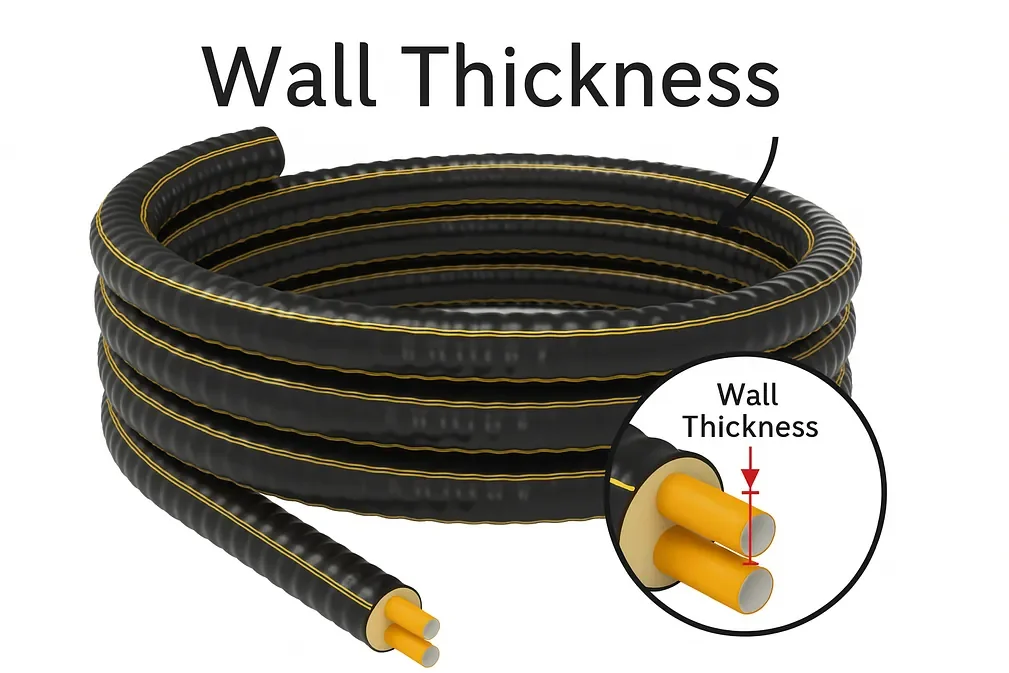
In today’s infrastructure projects, where efficiency, cost-effectiveness, and sustainability are no longer optional but essential, every design decision matters. One area where engineering innovation is delivering significant results is pipe wall thickness optimization.
RK Infra’s Fibreflex flexible pipes are designed with reduced wall thickness, but not at the expense of safety or strength. Instead, this is a strategically engineered feature that brings measurable advantages across the entire project lifecycle, from manufacturing to long-term operation.
1. Weight Reduction = Efficiency Gains
One of the most immediate benefits of reduced wall thickness is lower pipe weight.
Why it matters:
Simplified handling → Workers can move and position pipes without the need for heavy machinery in many cases.
Faster installation → Lighter pipes mean quicker laying and fitting, which is particularly important for large-scale infrastructure where delays can be costly.
Lower transport costs → More pipe length can be transported per truckload, reducing fuel usage and delivery times.
Real-world impact:
For a 10 km installation project, weight reductions can result in fewer truck trips, reduced crane or hoist usage, and significantly lower overall installation costs.
2. Material Efficiency = Direct Cost Savings
Reduced wall thickness means less raw material is used in production.
The advantages:
Lower manufacturing costs without sacrificing performance
Competitive pricing for procurement teams
Budget reallocation: savings can be invested into other parts of the project such as monitoring systems, better trench bedding, or additional protective layers where needed
This is particularly important for projects in competitive bidding environments, where every cost advantage can influence the outcome.
3. Enhanced Flexibility for Complex Installations
Flexible pipes are often chosen for their ability to adapt to challenging terrains and routing requirements.
With a reduced wall thickness, Fibreflex pipes achieve an even smaller bend radius, allowing:
Easier navigation around structural obstacles
Fewer joints and couplings, which lowers the risk of leaks
More efficient use of space in congested utility corridors
In many cases, this flexibility can reduce the need for costly re-routing or site modifications.
4. Maintaining Hydraulic Performance
A well-engineered thinner wall does not compromise the internal diameter — meaning flow performance remains strong.
The result:
Lower pressure drop across the length of the pipe
Reduced pumping costs over the system’s lifetime
Improved operational efficiency for both liquids and gases
This is particularly beneficial for industrial processes, municipal water systems, and energy infrastructure where flow reliability is critical.
5. Sustainability and ESG Compliance
Reduced wall thickness aligns directly with sustainability goals.
Environmental advantages:
Less material use = lower carbon footprint in manufacturing
Reduced transportation emissions due to lighter loads
Extended lifespan due to high-quality composite materials, reducing the frequency of replacements
With ESG compliance becoming a key factor in contract awards, this design choice can also enhance a project’s environmental credentials.
6. Addressing the Durability Question
A natural concern with thinner walls is whether strength is compromised.
With FibreFlex, it’s not.
Advanced material engineering ensures tensile strength, impact resistance, and pressure ratings meet or exceed industry standards.
Rigorous testing verifies performance under a variety of operational stresses.
Multi-layer construction provides built-in redundancy for added safety.
The end result is a pipe that delivers the benefits of reduced wall thickness without sacrificing reliability.
Why This Matters for Project Success
Every infrastructure project faces the same three pressures:
Deliver on time
Stay within budget
Meet performance and safety standards
By integrating reduced wall thickness into Fibreflex pipes, RK Infra addresses all three:
Time → Faster handling and installation
Budget → Material and transport savings
Performance → Maintained strength and hydraulic efficiency
The Bottom Line:
Reduced wall thickness in RK Infra’s Fibreflex flexible pipes is not a cost-cutting shortcut: it’s a precision-engineered feature that improves project efficiency, lowers costs, enhances flexibility, maintains performance, and supports sustainability.
To learn how FibreFlex can improve your next project, contact RK Infra’s technical team today.
